
Streamcombe Headwater
Wildwood Grove's first undertaking · A Somerset LNRS-aligned nature recovery programme.
Streamcombe Headwater is Wildwood Grove's first independently originated environmental undertaking. Set within 29.08 acres (11.77 hectares) of spring-fed pasture near Dulverton, the programme brings a defined landscape, existing professional evidence and Somerset's nature recovery priorities into a long-term framework for environmental investigation and potential recovery.
Programme status: The environmental programme design was completed on 15 November 2026. We are now seeking the professional expertise, research relationships and practical support needed to take Streamcombe Headwater into its first technical phase: reviewing the existing evidence and developing a seasonal investigation and monitoring programme. Appropriate restoration measures will follow from the findings and necessary professional assessments.
PUBLISHED PROGRAMME
Read the Streamcombe Headwater Public Programme — PDF, 13 pages
19 November 2026 · Environmental purpose, policy foundation, intended outcomes and programme of work.
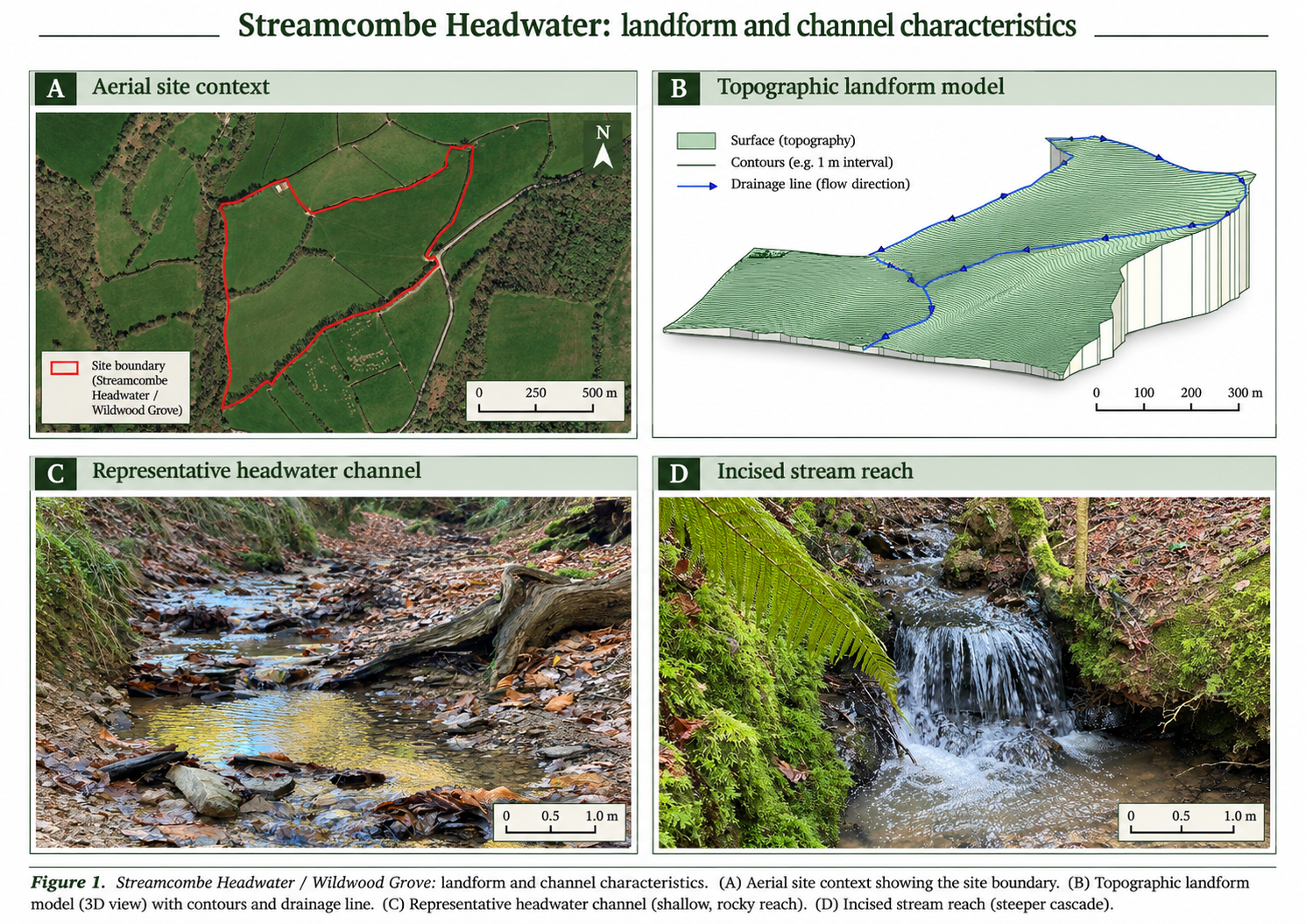
Streamcombe Headwater — Landscape and Watercourse Context
Illustrative composite showing the Wildwood Grove holding, its topographic setting and representative watercourse conditions. Prepared using site imagery, topographic modelling and field photographs. For environmental context; not intended for surveying or measurement.
Founding environmental outcome
Restore natural water function at source and enable self-sustaining ecological recovery, delivering the priorities of the Somerset Local Nature Recovery Strategy through a landscape-scale, process-led approach to nature recovery.
A landscape with an established starting point
The holding includes springs and wet areas, a small watercourse network, modified pasture, native hedgerows and other habitats, alongside a recorded agricultural drainage scheme dating from 1966. Existing ecological, soils and river-restoration assessments provide a substantial starting point for informed decisions.
The central opportunity is to understand how the landscape functions before selecting changes: what should be safeguarded, where natural processes may recover, and which interventions—if any—could be justified through evidence.
Nine intended environmental outcomes
Natural water function. Understand water movement, retention and seasonal wetness, and where appropriate support more natural function.
Freshwater and wetland habitats. Protect valuable wet features and investigate suitable opportunities for ecological recovery.
Ecological connectivity. Improve appropriate connections between grassland, hedgerows, streamside and neighbouring habitats.
Species and biodiversity. Safeguard existing wildlife and support locally appropriate species recovery where the evidence warrants it.
Water quality. Investigate water, sediment and nutrient pathways and address demonstrated pressures where feasible.
Flood and drought resilience. Explore local water-retention and dry-period resilience, assessing any wider effects separately.
Climate and soil resilience. Understand soil condition, habitat persistence and measurable climate implications without assuming a benefit.
Agricultural transition. Examine how grazing, cutting, historic drainage and changes in management influence soils, water and habitats.
Stewardship, learning and demonstration. Maintain an interpretable record and share appropriate findings for future decisions and learning.
From understanding to action
Understand → Observe → Interpret → Design → Restore where appropriate → Measure → Adapt
The programme begins by consolidating existing records and establishing the environmental starting point across relevant seasons. Specialist investigation will inform the appraisal of protection, natural recovery, land-management choices and any suitable physical works. Continuing observation will allow decisions and results to be understood over time.
Wildwood leads programme development and intends to coordinate future delivery and stewardship under appropriate landowner arrangements. Scientific methods, permissions and individual commissions will be agreed when their scope is established.
The published programme
The Streamcombe Headwater public programme sets out its environmental purpose, Somerset LNRS policy foundation, nine intended outcomes, supporting evidence and proposed stages of investigation, nature recovery and long-term stewardship.
It also explains how professional organisations, researchers and specialists can contribute relevant expertise and help develop the next phase.
Read the Streamcombe Headwater Public Programme — PDF, 13 pages
Public programme edition · 19 November 2026
Policy alignment · Evidence & Progress · Professional collaboration