
Catchment Pressures
What recognised catchment pressures apply to Wildwood Grove?
Evidence Sources
The information presented on this page is derived from:
Defra MAGIC environmental pressure mapping
River Exe Water Framework Directive priority-catchment mapping
Drinking Water Safeguard Zone mapping
Catchment Sensitive Farming priority mapping
Flood Risk Management priority mapping
Woodland Flood Risk and Woodland Water Quality priority mapping
Priority Habitat Network and Restorable Habitat mapping
Site hydrology, drainage, topography and catchment-connection evidence
Overview
Wildwood Grove sits within a recognised catchment pressure context.
The site is located near the beginning of the drainage network within the Streamcombe Valley system. Water generated within the holding leaves the site, enters the Streamcombe tributary system and continues downstream towards the River Brockey and River Exe.
The pressures listed below record the recognised catchment context associated with the site. They do not state that Wildwood Grove is responsible for catchment-scale pressure. They identify the mapped priorities and physical connections through which the site is relevant to wider catchment function.
Recognised Catchment Pressures
Recognised catchment pressures associated with Wildwood Grove include:
Upper-catchment pressure, because the site sits near the beginning of the drainage network within the Streamcombe Valley system.
Headwater source pressure, where spring emergence, wet ground, drainage features and early watercourse formation influence the first stages of downstream flow.
River Exe catchment pressure, with water leaving the site connected to the Streamcombe tributary system, then onward towards the River Brockey and River Exe.
Water Framework Directive catchment pressure, with the site falling within the River Exe Water Framework Directive Priority Catchment.
Drinking-water catchment pressure, with the site falling within the Drinking Water Safeguard Zone for the River Exe Surface Water.
Catchment Sensitive Farming pressure, with the site falling within a mapped Catchment Sensitive Farming Priority Catchment.
Diffuse agricultural pollution pressure, associated with nutrient movement, sediment movement, microbial risk and pesticide pathways within the wider agricultural catchment.
Phosphate pressure, with the site falling within a mapped Phosphate Issues Priority Area.
Faecal organism pressure, with the site falling within a mapped Faecal Indicator Organisms Issues Priority Area.
Surface-water pesticide pressure, with the site falling within a mapped Surface Water Pesticide Issues Priority Area.
Sediment pathway pressure, where rainfall, slope, soil condition, drainage and watercourse connectivity can affect sediment movement through the headwater system.
Flood-risk management pressure, with the site falling within a Flood Risk Management Priority Area classified as High.
Flow-response pressure, where rainfall intensity, soil saturation, drainage condition and slope influence how quickly water moves from the site into the wider catchment.
Natural flood-management pressure, with mapped Woodland Flood Risk Priority identifying the wider catchment need for vegetation, interception, storage and flow-slowing functions.
Woodland water-quality pressure, with the site falling within mapped Woodland Water Quality Priority Areas.
Water-temperature pressure, with the site falling within a Keeping Rivers Cool Priority Area.
Riparian-network pressure, where watercourse margins, shading, bank vegetation and channel condition affect downstream water quality and aquatic habitat resilience.
Groundwater pathway pressure, with the site falling within a High Groundwater Vulnerability Area.
Soluble rock pathway pressure, with the site falling within a mapped Soluble Rock Risk Area.
Climate vulnerability pressure, with the site falling within Climate Change Vulnerability Buffer Zones.
Drought and water-security pressure, reflecting national and catchment-level concern over long-term water availability, water retention and resilient water systems.
Habitat-network pressure, with the site falling within Priority Habitat Network High Spatial Priority and Restorable Habitat / Network Enhancement Zones.
Landscape-connectivity pressure, because the site sits within an agricultural headwater landscape where hedgerows, wet ground, grassland, woodland edges and watercourse features form part of the wider ecological network.
Cumulative catchment pressure, where agricultural land use, water quality, habitat condition, flood response, groundwater vulnerability and climate vulnerability overlap within the same physical site.
Evidence and monitoring pressure, because the catchment role of the site depends on measured behaviour over time, including rainfall response, water level, soil moisture, flow pathways, water temperature and downstream connectivity.
Pressure Context
The catchment pressure context at Wildwood Grove is defined by position and connection.
The site is not downstream of the problem. It is located at the headwater end of the system, where rainfall, groundwater emergence, drainage behaviour, soil moisture, wet ground, ditches and early watercourse formation begin to contribute to the wider catchment network.
The pressure record should therefore be read as a catchment-position and hydrological-connection context, not as a statement that Wildwood Grove is causing wider catchment failure.
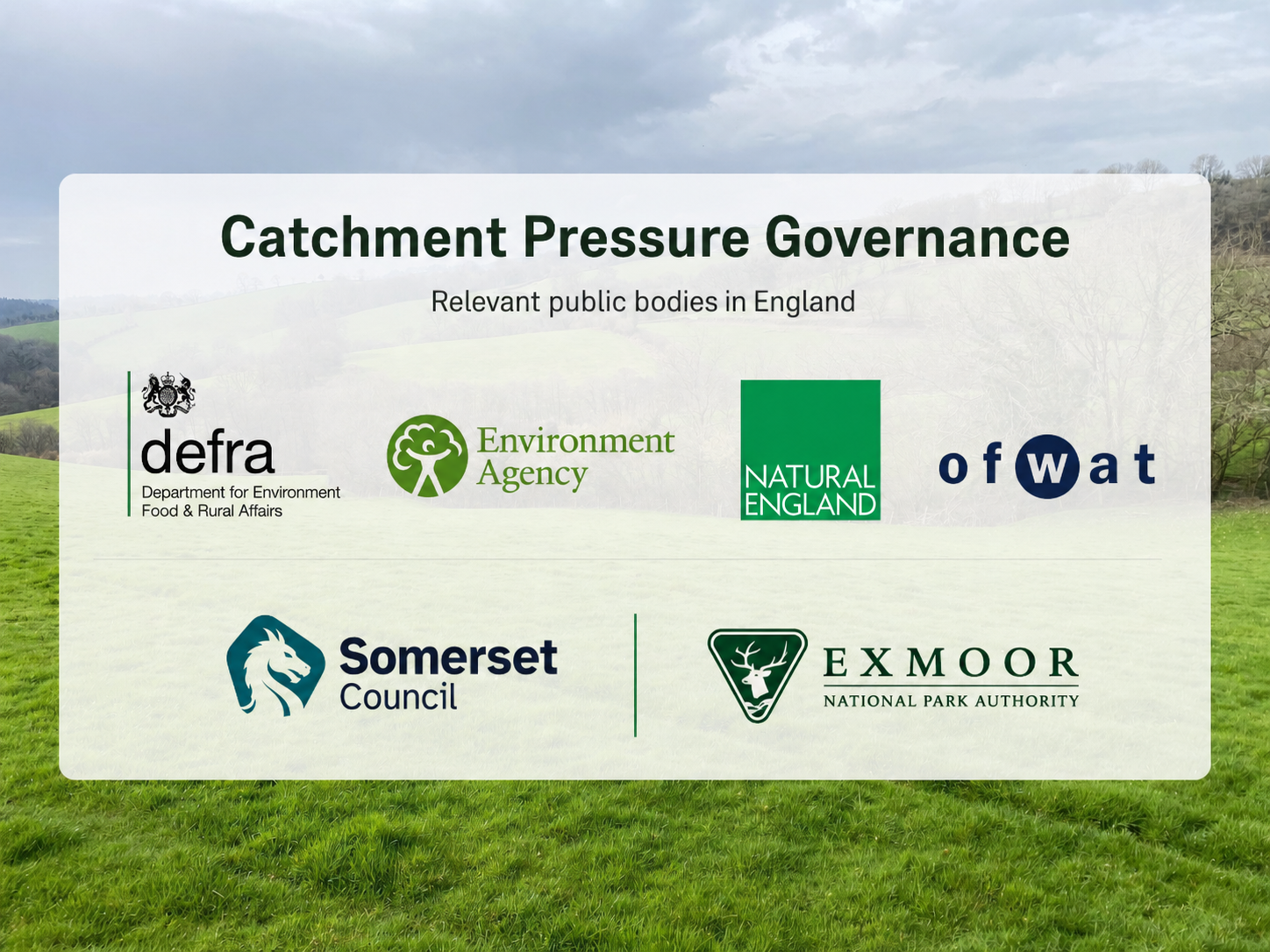
Figure 1. Catchment pressure governance
Summary image showing public bodies involved in catchment management, water quality, environmental regulation, water-sector oversight, landscape management and local flood-risk responsibilities relevant to Wildwood Grove.
From pressure context to practical delivery
This page records recognised pressure context. It does not claim that outcomes have already been delivered.
Fresh Start is being created to provide a monitored pathway through which pressure, intervention, system response and evidence can be connected over time.