
Agricultural Pressures
What recognised agricultural pressures apply to Wildwood Grove?
Evidence Sources
The information presented on this page is derived from:
Defra MAGIC environmental pressure mapping
Catchment Sensitive Farming priority mapping
Countryside Stewardship water-quality priority mapping
Drinking Water Safeguard Zone mapping
Water Framework Directive priority-catchment mapping
Groundwater vulnerability and soluble rock risk mapping
Site hydrology, geology, soils and drainage evidence
Overview
Wildwood Grove is an agricultural headwater holding within a concentration of recognised agricultural and water-quality pressure layers.
These pressures do not state that Wildwood Grove is causing pollution. They record the recognised agricultural pressure context that applies to the site and the physical pathways through which those pressures are relevant.
The site is relevant because agricultural land, spring-fed water movement, drainage infrastructure, soil condition, groundwater vulnerability and downstream catchment connection all occur within the same defined headwater holding.
Recognised Agricultural Pressures
The agricultural pressures associated with the site include:
Catchment Sensitive Farming Priority Catchment
Countryside Stewardship Water Quality Priority Area
Phosphate Issues Priority Area
Faecal Indicator Organisms Issues Priority Area
Surface Water Pesticide Issues Priority Area
Drinking Water Safeguard Zone pressure relating to the River Exe surface-water catchment
Water Framework Directive priority-catchment pressure relating to the River Exe
Agricultural diffuse pollution pressure
Nutrient movement from agricultural land into water
Phosphorus movement from land, soil and drainage pathways
Nitrogen movement from agricultural land into the water environment
Sediment movement from soil, runoff and land condition
Microbial contamination risk associated with faecal indicator organisms
Pesticide movement risk affecting surface water
Slurry and manure-management pressure within the wider agricultural regulatory context
Soil-management pressure affecting runoff, infiltration, erosion and water quality
Drainage pressure affecting how water, sediment and pollutants move through the holding
Wet-ground management pressure within an agricultural field system
Surface runoff pressure during rainfall events
Subsurface drainage and ditch-network pressure
Groundwater vulnerability affecting pollutant pathways
Soluble rock risk affecting subsurface movement and environmental sensitivity
Headwater transfer pressure, because water generated on the holding leaves the site and enters the Streamcombe tributary system
Downstream catchment pressure, because water leaving the site connects onward towards the River Brockey and River Exe
Regulatory pressure from emerging stronger agricultural pollution controls
Monitoring pressure, because national policy is moving towards clearer evidence, open monitoring and measurable environmental outcomes
Land-use pressure, because the site remains agricultural land within a catchment where water quality, soil condition, nutrients, sediment and runoff are recognised priorities
Pressure Context
These pressures overlap because the site is not only an agricultural field system. It is also a spring-fed headwater system, a drained landscape, a groundwater-connected site and part of the wider River Exe catchment.
The agricultural pressure context is therefore relevant to water quality, soil management, drainage behaviour, groundwater pathways, runoff response and downstream catchment function.
The pressure record should be read as a mapped and physical context, not as a statement of site-specific pollution causation.
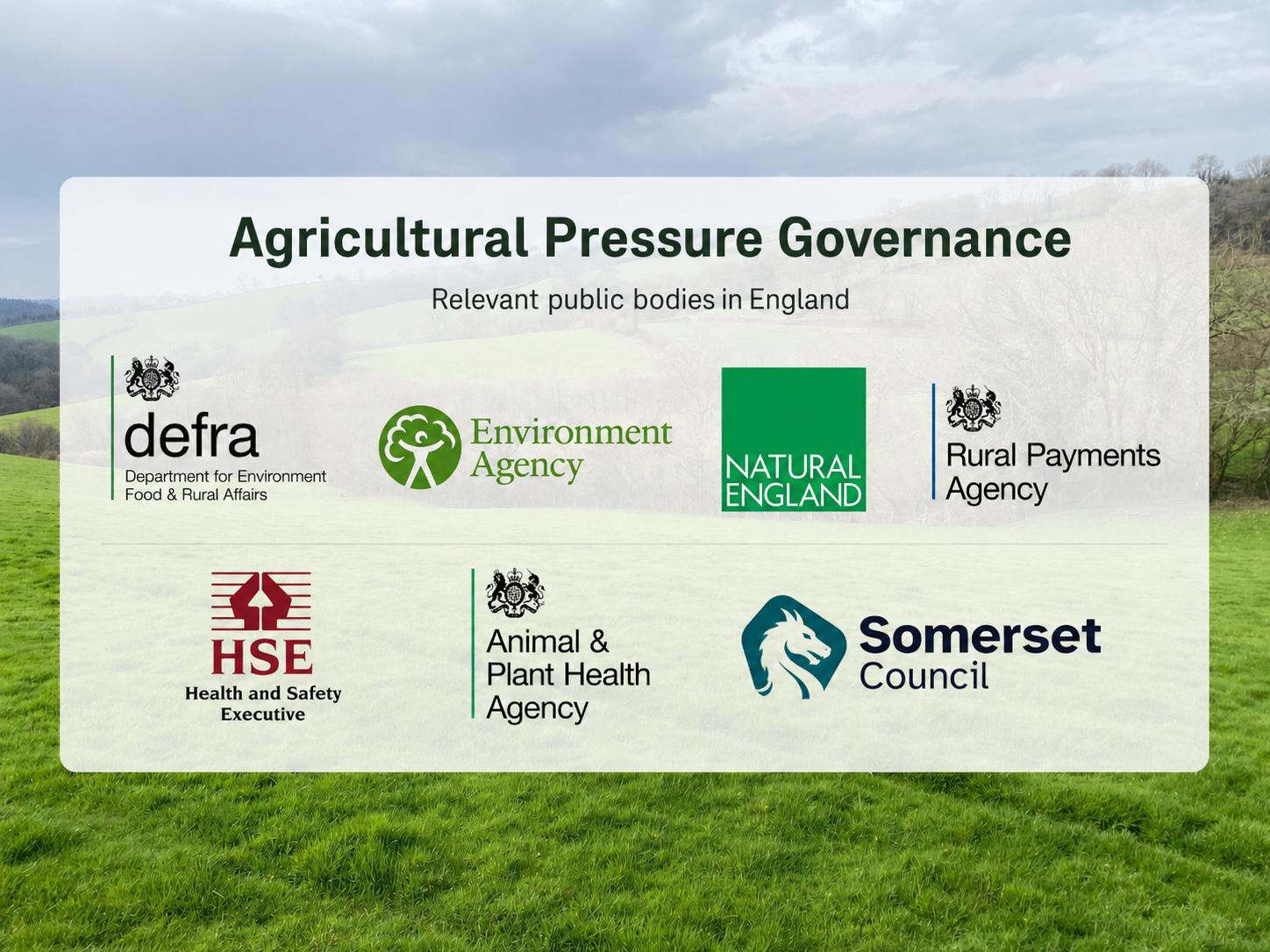
Figure 1. Catchment pressure governance
Summary image showing public bodies involved in catchment management, water quality, environmental regulation, water-sector oversight, landscape management and local flood-risk responsibilities relevant to Wildwood Grove.
From pressure context to practical delivery
This page records recognised pressure context. It does not claim that outcomes have already been delivered.
Fresh Start is being created to provide a monitored pathway through which pressure, intervention, system response and evidence can be connected over time.